Loading...
Searching...
No Matches
main.cpp File Reference
Test driver for the 1D heat conduction solver. Supports DuFort-Frankel, Richardson, Laasonen, and Crank-Nicolson schemes. More...
#include "grid.hpp"#include "io.hpp"#include "method.hpp"#include "methods/analytical.hpp"#include "solver.hpp"#include "types.hpp"#include "user_input.h"#include <filesystem>#include <iomanip>#include <iostream>#include <sstream>#include <stdexcept>#include <string>#include <vector>
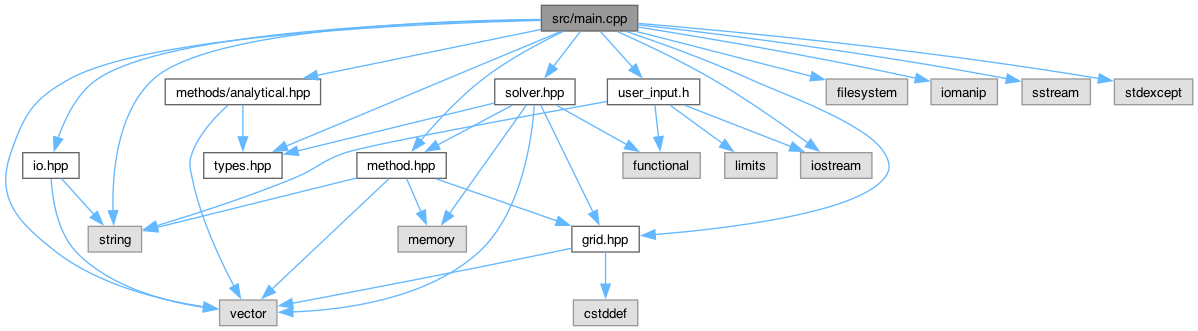
Include dependency graph for main.cpp:
Go to the source code of this file.
Functions | |
| void | run_simulation (const PhysParams &phys, const NumParams &num, SchemeKind scheme, const std::string &schemeName) |
| Run a single simulation with the specified scheme. | |
| int | main () |
| Main entry point for the 1D Heat Equation Solver. | |
Detailed Description
Test driver for the 1D heat conduction solver. Supports DuFort-Frankel, Richardson, Laasonen, and Crank-Nicolson schemes.
Definition in file main.cpp.
Function Documentation
◆ main()
| int main | ( | ) |
Main entry point for the 1D Heat Equation Solver.
This function orchestrates the entire simulation workflow:
- Defines physical and numerical parameters.
- Validates the grid.
- Prompts the user for method selection.
- Executes the selected simulation(s).
- Returns
- int 0 on success, 1 on error.
Definition at line 81 of file main.cpp.
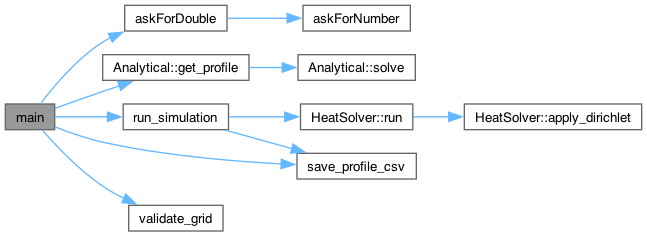
Here is the call graph for this function:
◆ run_simulation()
| void run_simulation | ( | const PhysParams & | phys, |
| const NumParams & | num, | ||
| SchemeKind | scheme, | ||
| const std::string & | schemeName ) |
Run a single simulation with the specified scheme.
This helper function avoids code duplication by handling the solver setup, directory creation, and output callback for any given scheme.
- Parameters
-
phys Physical parameters. num Numerical parameters. scheme The numerical scheme to use. schemeName String name for output directory (e.g. "Crank-Nicolson").
Definition at line 35 of file main.cpp.
Here is the call graph for this function:

Here is the caller graph for this function: